What a hub replaces
Five places to look becomes one.
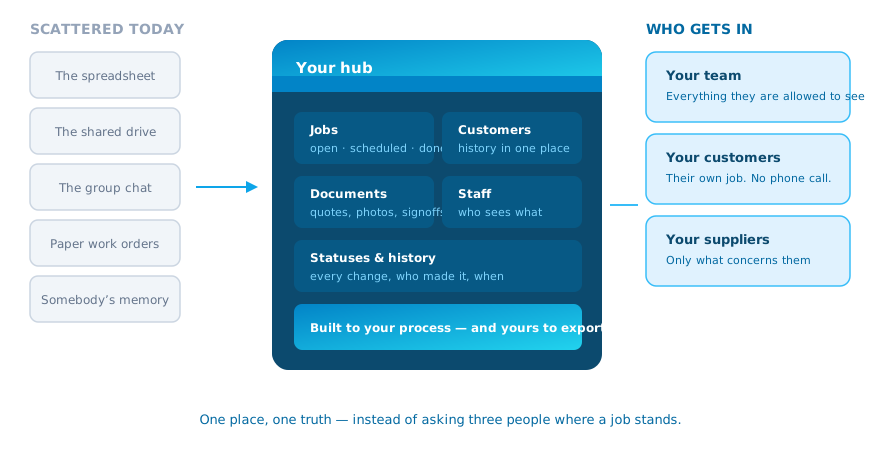
Swipe the diagram sideways to see it all
Jobs, customers, quotes, documents, schedules and staff in a single system, built around the way you already work. It replaces the spreadsheets, the shared drive and the "ask Dave, he knows" — it doesn't add another app on top of them.
This one takes weeks, not a day. If you need a site online tomorrow, start with the 24-hour website.
Projects start at
$2,900one-off build, then from $190/mo for hosting, backups and support.
A spreadsheet for jobs. A shared drive for documents. A WhatsApp group for whatever is urgent. Paper work orders in the van. An inbox full of quotes. And one person who remembers the rest.
Answering "is that finished?" means asking the office, then the crew, then checking two versions of a spreadsheet. The customer waits while you find out.
Once on the quote, again on the schedule, again on the work order, again on the invoice. Every retype is a chance to get the address or the price wrong.
Signed work orders live in a truck until Friday. Photos of the finished job sit on a technician's phone. Invoicing waits on both.
Every call is someone stopping what they are doing to look up information the customer could have read themselves.
None of that is a people problem. It is a "the information lives in six places" problem.
A hub puts it in one place, and gives each person only the part they need.
Five places to look becomes one.
Swipe the diagram sideways to see it all
We build the parts your business needs. Most hubs include some version of these six.
One record per job, from inquiry to paid. Status, assigned crew, notes, parts, dates and history — visible without asking anyone.
Every quote, job, document, invoice and phone note attached to the customer. New staff can pick up a ten-year-old account in a minute.
Built from the job instead of retyped, and filed against it — so nobody hunts a shared drive for "Quote_final_v3_REAL.pdf".
Who is doing what, today and next week. Move a job to another day or another technician and everyone sees the change.
The crew opens the job on a phone, ticks off the work, takes photos, captures the customer's signature and closes it out. No paper to bring back.
The office sees everything. A technician sees their own jobs. A customer sees only theirs. Nobody sees payroll except you.
Before-and-after photos, a meter reading, a damaged part, the signed sheet — captured on a phone and attached to the job as soon as there is signal. When a customer questions the work six months later, the evidence is already filed where you would look for it.
One system underneath, three different views. Start with one and add the others later.
Where the work actually gets run. Office and field, same information, different views.
Your customers log in and see their own work, so the update calls slow down — the answer is already on screen.
For subcontractors, suppliers and referral partners — access to their slice, and nothing else.
Once the information lives in one place, the follow-ups can send themselves: the reminder before the appointment, the invoice when the job closes, the nudge on a quote nobody has approved. That is task automation, and it is far cheaper to add to a hub than to bolt onto six spreadsheets.
See what we automateWeeks, not a day — and you see something working long before the end. Every stage produces a thing you can look at, click, or say no to.
We sit down with you and whoever really runs the day — the person with the spreadsheet, the dispatcher, a technician if we can borrow one. We walk a job from first phone call to final payment and write down every step, including the awkward ones. You keep the process map whether or not you hire us.
A plain-English document: what the hub will do, what it will not, what we need from you, the price, and the slice-by-slice plan with dates. Nothing starts until you have signed it, and nothing is added later without you seeing the cost first.
Before anything real is built you get a link you can click through: the job screen, the schedule, the phone view, the customer's view. Move things, rename things, tell us the field order is wrong. Changes here cost minutes; the same change after the build costs days, which is exactly why we do this.
Every two weeks you get a working piece on a private test link and a short call to walk through it. Jobs first, usually, then scheduling, then the portal. You are never waiting three months to find out whether we understood you.
Your customer list, open jobs and history come across from the spreadsheets. We run a test import first so you can check it against the originals, then a final one the day you go live. Your files stay exactly where they are as a backup.
One session for the office and a shorter one for the field crew — theirs is mostly "open job, do work, take photos, get a signature, done". We record both so new hires can watch them. Then we are on the phone through the first weeks while everyone settles in.
A first working version is a matter of weeks rather than months. A small jobs-and-customers hub is a much shorter build than one with a client portal, a field app and an accounting integration — and we do not know which one yours is until the discovery workshop, so we do not guess beforehand.
What we do commit to: real dates in the written scope before you pay anything, and a call the moment a date looks at risk — before it slips, not after.
The second column is the one that prevents arguments later, so we print it.
Or call (407) 737-9933 and describe it in two minutes.
Businesses with 5–50 staff, a real operation to run and no IT department. The examples below are hypothetical — they are the shapes of business a hub fits, not customers of ours.
Say you run a 12-person HVAC company: dispatch in the morning, work orders on paper, invoicing on Friday. The hub is the job board plus a phone view for the vans.
Picture a practice juggling intake forms, referrals and treatment plans across paper and a scheduler. The portal is where patients complete forms before they arrive.
Matters, documents, deadlines, and a client who wants to know where things stand. The client portal answers that without a paralegal drafting an email.
Imagine a courier outfit with drivers, subcontractors and proof-of-delivery photos landing in three different WhatsApp threads. One hub, one thread.
Vehicles in, estimates out, parts on order, the phone ringing. The hub tracks the job and lets the customer approve the estimate from their phone.
Volunteers, cases, grant paperwork and a board that wants a report. A hub keeps the records straight when the staff list changes every year.
Not on the list? The industry matters less than the shape of the problem. If work moves through stages, more than one person needs to see it, and it currently lives in a spreadsheet, a hub fits.
A hub is the biggest thing we build and it is genuinely quoted case by case. Here is the starting point and, more usefully, what moves the number.
Build, starting at
$2,900One-off, for a first hub covering jobs, customers and documents. Your figure comes from the written scope after the discovery workshop — this is where the conversation starts, not where it ends.
Paid in stages against the slices, not all up front.
Running it, from
$190/moHosting, SSL, automatic backups, monitoring, security updates and support for the whole team. Not per user — the price is the same whether eight people log in or forty.
Includes an agreed allowance of small changes each month.
Care plan (lighter option), from
$69/moThe same hosting, backups and updates without the larger support allowance. Suits a small hub that is finished and stable, or an owner who mainly wants it kept safe and online.
You can move between plans as the hub grows.
Subscription software charges you every month for every person who touches it, forever, and the bill goes up when you hire. A hub is built once and it is yours — the database, the screens and the data in them. Taking on five people does not change what you pay us.
The monthly figure covers keeping it hosted, backed up, patched and supported. It is not rent on your own system.
The ones people ask before they spend this much.
Sometimes you should, and if a product covers your process we will tell you so rather than sell you a build. The usual sticking point with off-the-shelf products is that they expect the business to work their way. A hub goes the other direction: we watch how you already work and build that. You also stop paying per person, per month, forever.
Only if we build it badly. The point is subtraction: the job spreadsheet, the scheduling spreadsheet and the document folder go away because the hub does what they did. If a tool you already pay for is working — the accounting package, usually — we connect to it and leave it alone instead of rebuilding it.
That is why the prototype comes before the build, and why we want a technician in the workshop. The field view is deliberately small: open the job, do the work, take photos, get a signature, done. If a screen has to be explained twice, the screen is wrong, and fixing it is part of the job.
We import what is in them, show you a test import to check against the originals, and you keep the files. The data in the hub stays yours: you can export it whenever you like, and if you ever leave us you take it with you. We do not hold anyone's records hostage.
No — and anyone who says yes has not understood the job. The 24-hour promise belongs to the 24-hour website: 24 hours starting the moment we have your content and you have approved the layout. A hub changes how your business actually operates, so it takes weeks and gets a workshop, a prototype and a written scope first. If cash flow is the constraint, you can start with the website and add the hub later — the two are separate pieces of work.
Then the hub changes with it — that is the advantage of owning it. Small adjustments come out of the monthly support allowance; a new module is quoted like any other piece of work. Because it was built in slices, adding one later works exactly the same way as adding one during the original build.
Cyrus, who handles IT and project management, and Tristan, who is the full stack developer. Two people, based in Orlando. The pair who run the workshop are the pair who build it and the pair who pick up the phone afterwards — nothing gets handed to an account manager you have never met.
Tell us how a job moves through your business today. We will tell you honestly whether a hub is worth it, what it would cover and what it would cost — in writing, before you commit to anything.
support@cyrusmanagementgroup.com · Orlando, FL
Free quote
Cyrus Management Group
Orlando, FL · Replies right away